
In the Age of AI, We Are Looking for the Voices of Ordinary People
Recently, the Korean government and industry have been pushing strong industrial support policies with the goal of becoming an “AI powerhouse.”
In our daily lives as well, we are increasingly conversing with and relying on generative AI in both work and everyday activities.
However, there is something we must not forget when developing and using AI.
The source of the vast amounts of data used by AI, including generative AI, is ultimately people, and the subjects of its predictions and decisions are also people.
An even greater problem is that what AI learns from and reflects is the world as it exists today—a world that has long discriminated against and marginalized certain groups of people.
Our society—and AI itself—must protect human dignity and must not discriminate against people or violate human rights.
Yet as this mysterious and complex AI environment deepens, we may lose our way.
Can AI and human rights coexist? How can we find that path?
Will Korea AI Framework Act, which will come into force in January next year, be able to protect human rights?
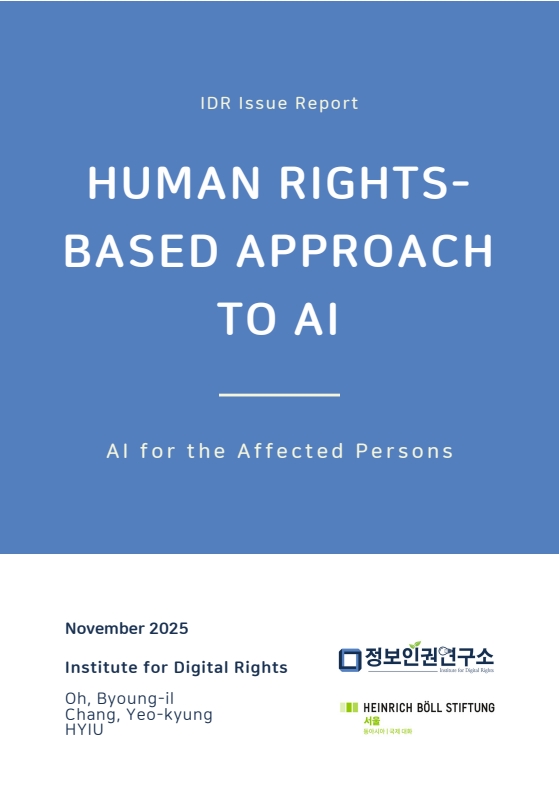
The Institute for Digital Rights has published an issue report titled A Human Rights–Based Approach to AI that reflects these concerns.
There is nothing extraordinary in it. We have simply gathered cases and institutional examples that approach AI issues from a human rights perspective.
Amid the AI industrialization driven by states and corporations, we sought to examine the relationship between AI and human rights from the standpoint of people who are often hard to see—especially ordinary people who are affected by AI.
In truth, this is not a story unfamiliar to us.
It is that we cannot stop striving to secure the human rights responsibilities of AI and to protect people affected by the risks posed by AI.
At this moment, when everyone is running forward without even knowing where the future is headed, we believed it was important to reaffirm our principles.
If we are to hold expectations about the benefits that AI can bring to people, we must focus even more closely on its impacts on people.
This is the core objective of a human rights–based approach to AI.
We hope you will take a look at the report and join us in discussing how we can build a future in which AI and human rights coexist.
* This publication was produced with the support of the Heinrich Böll Foundation.
