
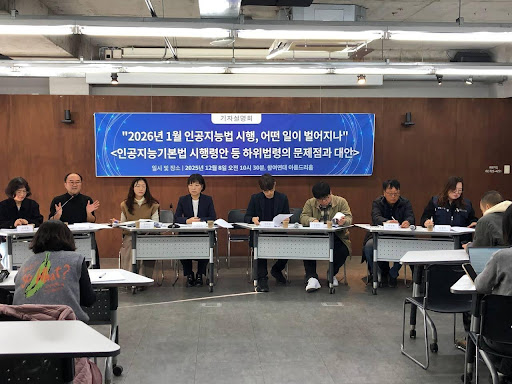
“What Will Happen When the AI Framework Act Takes Effect in January 2026?”
– Digital Rights, Education, Labor, Culture, Healthcare, and Consumer Groups Express Concerns
“Subordinate regulations that broadly exempt high-risk operators from responsibilities leave people’s safety and human rights exposed to AI-related risks”
- On Monday, December 8, 2025, at 10:30 AM, 22 labor and civil society organizations held a press briefing at PSPD’s the Areumdri Hall in Seoul to criticize the problems in the government’s proposed Enforcement Decree and other subordinate regulations for the “Act on the Promotion of Artificial Intelligence Development and the Establishment of a Trust-Based Environment” (hereinafter, the ‘AI Framework Act’) and to call for policy alternatives from civil society. Digital rights, education, labor, culture, healthcare, and consumer groups unanimously pointed out that the subordinate regulations, which broadly exempt high-risk operators from their responsibilities, risk leaving affected people’s safety and human rights exposed to the dangers of AI.
- The subordinate regulations for the AI Framework Act, which was promulgated on January 23, 2024, and is scheduled to take effect on January 22, 2026—namely, the draft Enforcement Decree, draft Notices, and draft Guidelines—were released on September 17. Among these, the draft enforcement decree underwent partial clause revisions on November 13 and is currently undergoing a legislative notice period to collect public comments until December 23. The AI Framework Act has faced criticism from civil society for several reasons: ▲ it contains no provisions prohibiting AI systems that influence a person’s subconscious or exploit vulnerabilities such as age or disability to induce certain behaviors; ▲ the scope of “high-impact AI operators” is narrowly defined; ▲ the obligations imposed on high-impact AI operators are insufficient, and even when violations occur, administrative fines are imposed only if the operator fails to comply with a corrective order from the Ministry of Science and ICT, raising doubts about the Act’s effectiveness; ▲ it includes no provisions on the rights or remedies of individuals affected by AI; and ▲ it broadly excludes AI used for national defense or national security purposes from the Act’s application. Given these limitations in the AI Framework Act’s provisions for preventing AI-related risks, the subordinate regulations must supplement measures to protect people’s safety and fundamental rights. However, the current drafts often fail to specify the concrete protective measures delegated by the law. Worse still, they add multiple grace periods concerning business operators’ responsibilities that are not stipulated in the Act itself.
- Oh Byoung-il, president of the Digital Justice Network, pointed out that although the law delegated the authority to designate additional categories of high-impact AI to the enforcement decree, the draft decree contained no provisions on this matter. As a result, AI systems that pose risks to people’s safety and human rights—such as facial recognition in public spaces and emotion recognition in workplaces and schools—fall into regulatory blind spots. He particularly criticized the draft for classifying certain businesses deploying AI for operational purposes—such as hospitals, recruitment firms, and financial institutions—as mere ‘users’, thereby entirely exempting them from the responsibilities of “operators” (e.g., risk management, explainability, and human oversight). Businesses that actually deploy AI systems, such as news providers or video producers, were also classified as “users”, thereby being exempted from the obligation to label deepfake content. He argued that AI business operators deploying AI for business purposes and directly affecting individuals through their systems should bear appropriate responsibilities as “AI operators”.
- Kim Ha-na, Chairperson of the Digital Information Committee of MINBYUN(Lawyers for a Democratic Society), pointed out that the draft enforcement decree failed to specify key responsibilities for high-impact AI operators, with many such matters appearing only as non-binding recommendations in public notices or guidelines. She emphasized that important matters delegated by law, and those directly affecting people’s rights and obligations, must be stipulated in the enforcement decree. Furthermore, she raised concerns that the draft enforcement decree, by exempting certain fact-finding investigations not authorized by law and allowing an unspecified extended grace period, may exceed its delegated authority. She further criticized this approach as prioritizing corporate interests over people’s safety and the protection of human rights, even in cases where AI products and services cause safety incidents or human rights violations.
- Meanwhile, voices from various sectors raised concerns about problems found in the draft subordinate regulations. Kim Hyun-joo, the Director of Steady Call Center Branch of KPTU(Korean Public Service and Transport Workers’ Union), highlighted that contact center workers are already suffering serious harm from AI deployment, including layoffs, surveillance, responsibility gaps, and customer safety risks. She criticized the lack of legal mechanisms to protect call center workers and customers affected by AI, emphasizing the urgent need to establish such protections.
- Following this, Choi Sun-jung, Director of Institute for True Education and Spokesperson of KTU(Korean Teachers and Education Workers Union), expressed concern that the government’s AI talent development policy subordinates education to industrial demands, weakening the rights of students and teachers and the public nature of education. He called for a policy shift towards cultivating critical AI citizens capable of addressing the ethical challenges posed by technology.
- Furthermore, Ha Jang-ho, the Policy Committee Chair of Cultural Action, pointed out that government policies overly focused on promoting the AI industry have resulted in a serious lack of public discussion and policy responses to the severe threats to livelihood, labor rights violations, and the potential collapse of the social and cultural foundations in the cultural and artistic sectors.
- Jeon Jin-han, the Policy Director of Korean Federation of Medical Groups for Health Rights, also expressed concern that insufficiently validated AI systems are being indiscriminately deployed in healthcare settings, leading to serious risks such as misdiagnoses, safety hazards, and unjustified medical billing. He criticized that, despite these dangers, the AI Framework Act fails to regulate such practices, effectively leaving the medical field as a regulation-free zone.
- Finally, Jeong Ji-yeon, the Secretary General of Consumers union of Korea, expressed concern that the introduction of AI has caused consumers to experience inconvenience when forced to interact with chatbots and has infringed upon their right to human contact. She pointed out that when AI-related harm occurs, consumers are effectively left to bear the burden of proof. She stressed the urgent need for safeguards to protect socially vulnerable groups and institutionalize consumers’ right to participation.
- As building a growth-oriented ‘AI powerhouse’ is the Lee Jae-myung administration’s top national priority, protecting the rights of those affected by AI-related risks is even more crucial. Korean Civil society has consistently emphasized that preparing for the dangers AI poses to people’s lives, safety, fundamental rights, and democracy is the state’s duty, while proposing policy alternatives. Following today’s(December 8th) press briefing, civil society submitted its initial opinion statement on the subordinate legislation for the AI Framework Act, including the draft enforcement decree, draft notices, and draft guidelines. Civil society opinion statements for specific sectors such as labor, education, culture and arts, healthcare, and consumers will continue to be submitted in the future. / End /
▣ Press Briefing Overview
- Title: “What Will Happen When the AI Framework Act Takes Effect in January 2026?” – Press Briefing on <Problems and Policy Alternatives in the Draft Enforcement Decree and Other Subordinate Regulations of the AI Framework Act>
- Date & Location: December 8, 2025, 10:30 AM / PSPD’s Areumduri Hall
- Co-hosted by: Digital Information Committee of MINBYUN, Digital Justice Network, Institute for Digital Rights, PSPD, KPTU, Headquarters of the Movement to Stop Healthcare Privatisation and Achieve Free Healthcare, Cultural Action, Media Christian Solidarity, The Democratic Legal Studies Association, Korean Federation of Medical Groups for Health Rights (Korean Nurses association for Health Rights, Korean Pharmacists for Democratic Society, Korean Dentists Association for Healthy Society, Solidarity for Worker’s Health, Association of Physicians for Humanism, Doctors of Korean Medicine for Health Rights), Civil Society Organizations in Korea, Citizen’s Mediation Center Seoul YMCA, Policy Committee of People’s Coalition for Media Reform, Human Rights Education ONDA, KTU, KMWU, KCTU, Solidarity for Child Rights Movement ‘Jieum’, Joint Committee for Freedom of Expression and Against Media Repression, Consumers Union of Korea, WomensLink, Korean Women’s Federation for Consumer (22 organizations listed above)
- Program
- Moderator: Lee Ji-eun, Senior Staff Member, Public Interest Law Center, PSPD
- Core Issues of the Subordinate Legislation draft (1): Oh Byoung-il, President, Digital Justice Network
- Key Issues in the Draft Subordinate Legislation (2): Kim Ha-na, Chairperson, Digital Information Committee, MINBYUN
- Sector-Specific Problems and Proposals in the Draft Subordinate Legislation
- Labor: Kim Hyun-joo, Branch Director, Steady Call Center Branch, KPTU
- Education: Choi Sun-jung, Director of Institute for True Education and Spokesperson of KTU
- Culture and Arts: Ha Jang-ho, Policy Committee Chair, Cultural Action
- Healthcare: Jeon Jin-han, Policy Director, Korean Federation of Medical Groups for Health Rights
- Consumers: Jeong Ji-yeon, Secretary General, Consumers union of Korea
▣ Attachment (Korean)
Civil Society Opinion Statement on the Draft Enforcement Decree
Civil Society Opinion Statement on the Public Notice and Guidelines
Press Briefing Statement
